

Test Standard: MIL-STD-810H Method 503.7 — Temperature Shock
Military semiconductor components operate in the harshest environments on Earth — from the -55°C cold of arctic deployments to the +125°C heat of engine compartments, often transitioning between these extremes in minutes. A radar system moved from a heated hangar to a -40°C flight line experiences a temperature shock. A guided missile transported from desert storage to high-altitude launch undergoes rapid decompression and temperature change simultaneously. MIL-STD-810 Method 503 is the standard that defines how to test for these scenarios.
Military-grade semiconductors — whether COTS (Commercial Off-The-Shelf) devices screened to military requirements, or purpose-built MIL-STD-883 compliant devices — must survive thermal environments that commercial components never encounter. Key military thermal shock scenarios include:
· Air-to-air deployment: Equipment transferred from a heated aircraft cabin (-18°C at altitude) to ground operations in desert heat (+50°C+)
· Storage-to-operation transitions: Missiles stored at -40°C in arctic depots, then activated in warm conditions
· Vehicle-mounted systems: Electronics in armored vehicles transitioning from cold-soak to engine-bay heat
· Naval applications: Shipboard electronics exposed to rapid temperature changes when moving between climate-controlled interiors and open decks
Each of these scenarios can cause immediate failure or latent damage that manifests as field failure weeks or months later.
Method 503.7 defines three procedures for temperature shock testing:
Procedure I — Constant Cycle Shock:
· Two temperature extremes, constant throughout the test
· Typical: +71°C and -57°C (or +71°C and -54°C)
· Transfer time: ≤1 minute
· Dwell time: 1 hour or until thermal stabilization
· Cycles: 3 minimum (most programs require 25+)
Procedure II — Cycle Sequence Shock:
· Temperature extremes vary across cycles to represent diurnal/mission cycles
· More representative of actual field exposure
Procedure III — Multiple Threat Shock:
· Multiple temperature extremes in a single cycle
· Used for multi-environment platforms
The standard emphasizes that test temperatures should be derived from the anticipated life cycle environment (LCE) of the materiel, not generic default values.
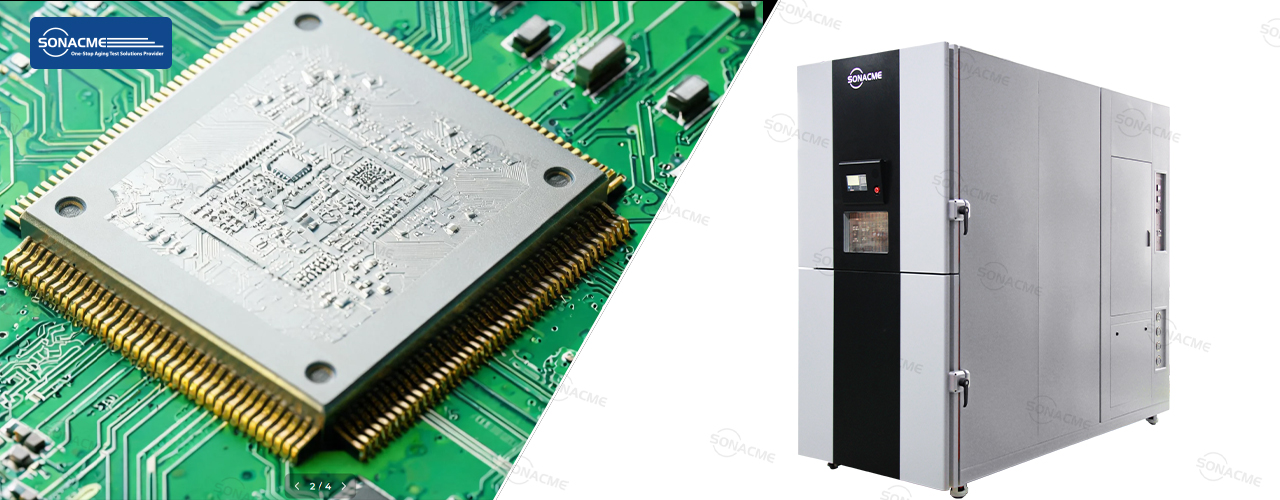
SONACME's Two-Zone Thermal Shock Test Chamber is specifically designed to meet the demanding requirements of MIL-STD-810 Method 503. The elevator-type basket transfer achieves the sub-1-minute transition time required by Procedure I, while the independently controlled hot and cold zones maintain precise temperature stability during soak periods.
Key Technical Parameters for Military Testing:
Parameter | Specification | Method 503 Requirement |
High Temperature | +60°C to +200°C | Covers +71°C and higher |
Low Temperature | -65°C (Condition C) | Covers -57°C and lower |
Transfer Time | <10 seconds (basket) | ≤1 minute |
Temperature Stability | ±0.5°C | Meets MIL-STD-810 |
Volume | Up to 1000L | Accommodates LRU-level assemblies |
Load Capacity | Up to 100 kg | Supports rack-mounted equipment |
Construction features critical for military testing:
· Full-welding SUS304 inner chamber: Ensures hermetic sealing, preventing cross-contamination between zones — essential for repeatable military qualification testing
· Tecumseh/Bitzer/GEA BOCK compressors: Provide reliable cooling to -65°C, meeting the most severe Method 503 cold extremes
· Schneider/Carlo Gavazzi/Mitsubishi electrical components: Military-grade reliability for the control system
· SONACME self-developed controller: Supports programmable multi-cycle testing with automatic temperature logging
A semiconductor-specific Method 503 test plan should include:
1. Life cycle environment analysis: Define the deployment scenarios, storage conditions, and transport profiles that create thermal shock
2. Temperature selection: Use LCE data to select hot and cold extremes — do not default to generic values
3. Cycle count: Minimum 3 cycles for screening; 25+ for qualification; 100+ for highly critical applications
4. Interim electrical testing: Measure key parameters (Vf, Vce(sat), leakage current) between cycle sets to detect parametric drift
5. Post-test analysis: Visual inspection at 10-20x, electrical test, and DPA for any failures
SONACME Technology is a CASC (China Aerospace Science and Technology Corporation) permanent member and a National High-tech Enterprise. Our chambers are used in aerospace and defense applications where failure is not an option. The LOW GWP technology with R-449A refrigerant provides up to 40% energy savings — reducing operating costs for the high-cycle-count testing that military qualification demands.
For military-grade semiconductor components, thermal shock testing per MIL-STD-810 Method 503 is not optional — it is a mission-critical reliability gate. SONACME's Two-Zone Thermal Shock Test Chamber provides the precision, repeatability, and compliance that military applications demand.
Contact SONACME Technology to discuss your MIL-STD-810 Method 503 testing requirements and learn how our chambers can support your military semiconductor qualification program.